A Soulful Ballad
A reflection on finding your own love song from The Ballad of Wallis Island

Alert: This reflection contains film spoilers.
I don’t know what I expected from the film The Ballad of Wallis Island. A love story, maybe. Actually a love story most probably, since I was drawn in by the promise of a once-famous folk-music duo (and former couple) reuniting after a long hiatus on a remote island for a private gig.
I wasn’t wrong and I wasn’t disappointed. There was love to be found here, just not in the places I expected. Perhaps it is even true love, not the hollow romance I often seek out for fleeting comfort and hope in fiction, and in life.
We find it first in Charles (Tim Key): lovely and lonely, kind, bumbly, hapless. A widower living quietly with the ache of a great love lost. His love for his late wife, Marie, lingers everywhere: steeped in nostalgia, alive through memory, ritual, and music. He keeps their connection breathing through what was a shared passion for the folk duo McGwyer Mortimer.
That love proves far more powerful than the millions of pounds he’s won on the lottery (Twice, yes, twice). Money can’t buy her back, can’t resurrect what was, and it certainly can’t ease the loneliness that has him filling any silences with light jokes, betraying the darkness underneath. So Charles does the closest thing to reconnecting with Marie, and love, that he can imagine: he pays Herb McGwyer (Tom Basden) and Nell Mortimer (Carey Mulligan) to come play a private gig on the island. For him. For Marie.
Herb arrives on the island pulled by the money; half-a-million pounds for a single performance. Yet he’s clearly clutching at something else too. At times, it feels like the past. At times, it’s Nell, enigmatic, steady, already moved on. At times, it’s the promise of his solo career: a new album, the intoxicating pull of recognition.
He suggests that he and Nell reunite. Tour again. Recreate the magic. We assume he means both the music and the love. He even reclaims his old guitar, the one Charles bought at auction. What can recreate that hollow love, rendered in reverence from a host of fans?
Then there’s the mocked-up cover for his next solo album Herb receives: him seated on a throne, teeth blindingly white, posture regal. A king. A figure to be worshipped. Yet it’s not him. Even he says musicians don’t have teeth like that. We don’t recognise the man smiling back.
I often find myself in the same existential crisis. Where is the truth? What actually makes up an authentic life? How can I be my most self-actualised self? Where is the real me in the midst of all this? Where is the love?
I’ve worked out it’s not in the past, it’s not in an idealised future. I mean it’s clearly not achieving the things we’re told to strive for by invisible societal forces: the money, the house, the car, the accolades, the applause.
Most of all, it’s not in looking for love outside myself. The hollow romance. Even love from a mum, a dad long gone from my life. Is that truth? I don’t think so.
So where is it found?
Herb doesn’t discover the answer in the past, or with Nell. He begins to understand himself through Charles, and through Charles’ deep, uncomplicated love of McGwyer Mortimer’s music. He witnesses how that music becomes a living bridge between Charles and his deceased wife, not as escapism but as connection.
This is where Herb finally sees the true power of his gift and his art.
Not as currency.
Not as branding.
But as communion.
Beyond fame. Beyond money.
Here, finally, is something like unfettered self-actualisation.
His music goes on to bridge another connection: between Charles and Amanda, the island’s shopkeeper. Herb plays a gig for them on the beach. No spectacle. No throne. Just presence.
We think Herb leaves with the guitar and the half-million-pound payment. We see him on the boat, the suitcase that held the cash in hand. Yet when Charles returns home, he finds both the money and the guitar waiting for him.
Herb has honoured Charles’ earlier request to sign the guitar, but it’s in the signature that the transformation is revealed:
“Charles, Your greatest fan, Chris Pinner.”
Herb signs the guitar with his REAL name.
On that island, where he is stripped of performance and expectation, and pushed to face the past with all its regrets, he finds himself. Through Charles, through kindness, grief, and genuine love, his heart opens. From there, an authentic life becomes possible.
In the final scene, we see him again on the boat, opening the suitcase, not for money, but for an apple. He takes a great, deliberate bite.
It’s a poignant moment. An invitation to eat life. So let’s eat it, my friends.
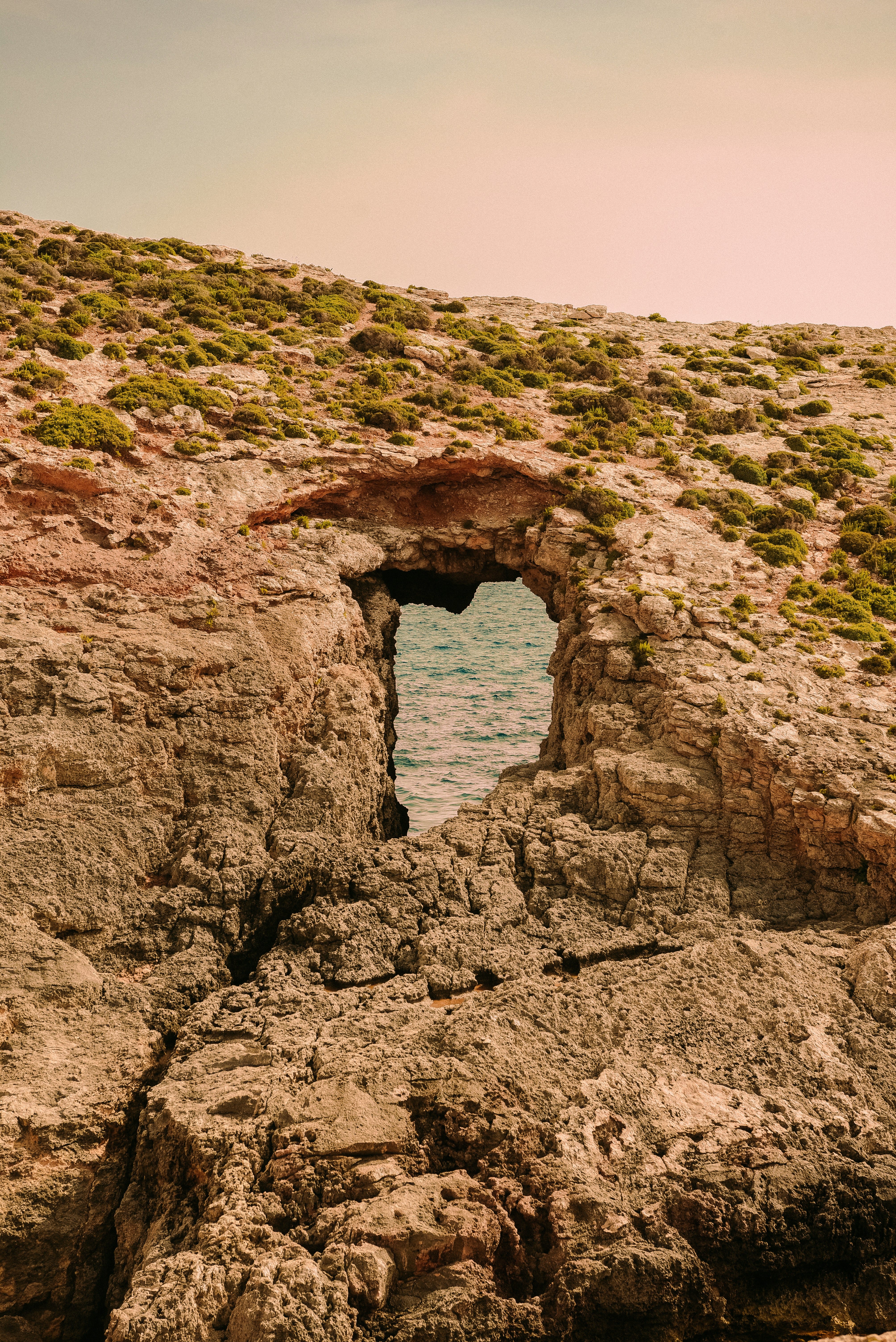
Image source: Photo by Tânia Mousinho on Unsplash
Also Chris Pinner = Chrisp Inner. Am I right? Omg I think too much
P.S. The movie is actually funny too. You wouldn't know it from my piece 😆